How to Teach Spanish Descriptive Adjectives: Free Game (Spanish 1)
Want 5 free no-prep Spanish activities? Click here
If you have been wondering how to teach Spanish descriptive adjectives so that every student gets to say them out loud, this is the game I use with Así se Dice 1 Chapter 1, and it is free. It is a Spanish adjectives game in the Yo tengo, ¿quién tiene? style, with 61 picture cards, and each card asks which student has the next word.
The whole game is below: my instructions, the 61 cards, four to a page, and two pages of blank cards you can edit. Print it, laminate it, cut it out, and you have one of your Spanish 1 activities for Chapter 1 ready to play.
What students do in a Yo tengo, ¿quién tiene? game
A descriptive adjective tells what a person or thing is like, such as alto, simpático or inteligente. This game is made for Así se Dice 1 Chapter 1, so the cards hold those adjectives and the words that go with them: nationalities, school subjects, people, and small words like muy, pero and también.
A Yo tengo, ¿quién tiene? game is a chain. Every card answers the question on the card before it and then asks a new one. Each picture stands for a word that is not written on the card, so students have to think of the Spanish word for their picture and listen closely for the question that matches it.
The Spanish descriptive adjectives Yo tengo game at a glance
- Grade: Spanish 1 (Así se Dice 1, Chapter 1)
- You need: the 61 cards (printed, laminated and cut out) and a stopwatch if you want to time the class
- Students will be able to: say the Spanish word for the picture on their card, read it aloud after Yo tengo, and listen for the word that is asked about with ¿Quién tiene?
The 61 Spanish words on the cards
Every question names one word, and the next card shows that word as a picture. Here are all 61, as they are written on the cards.
- Describing words (23): aburrido, ambicioso, feo, joven, difícil, cómico/gracioso, bueno, bonita, inteligente, interesante, perezoso, nuevo, simpático, antipático, pelirrojo, serio, alto, pequeño, guapo, malo, grande, rubio, moreno
- Nationalities and languages (14): chileno, mexicano, guatemalteco, peruano, puertorriqueño, venezolano, ecuatoriano, colombiano, cubano, dominicano, argentino, español, el inglés, el francés
- School subjects and class (8): los estudios sociales, la historia, las matemáticas, la música, la educación física, la ciencia, el arte, la clase
- People (5): el amigo, la muchacha, el muchacho, el alumno, el profesor
- Questions and small words (11): ¿de qué nacionalidad?, de dónde, cómo, quién, oye, mucho gusto, muy, bastante, mismo, también, pero
Before you play
Print, cut and laminate all of the cards before class. The free file is 19 pages: 16 pages of picture cards, 2 pages of blank cards and the How to Play page.
- Print pages 1 to 16: four cards to a page, 61 cards in all (the last page has one card and a note about the blank cards).
- Laminate the pages, then cut the cards apart.
- Look for the cards marked FIRST and LAST. The FIRST card starts the game.
- If you want to time the class, have a stopwatch ready and a way to project it.
The cards: a picture on top, a question at the bottom
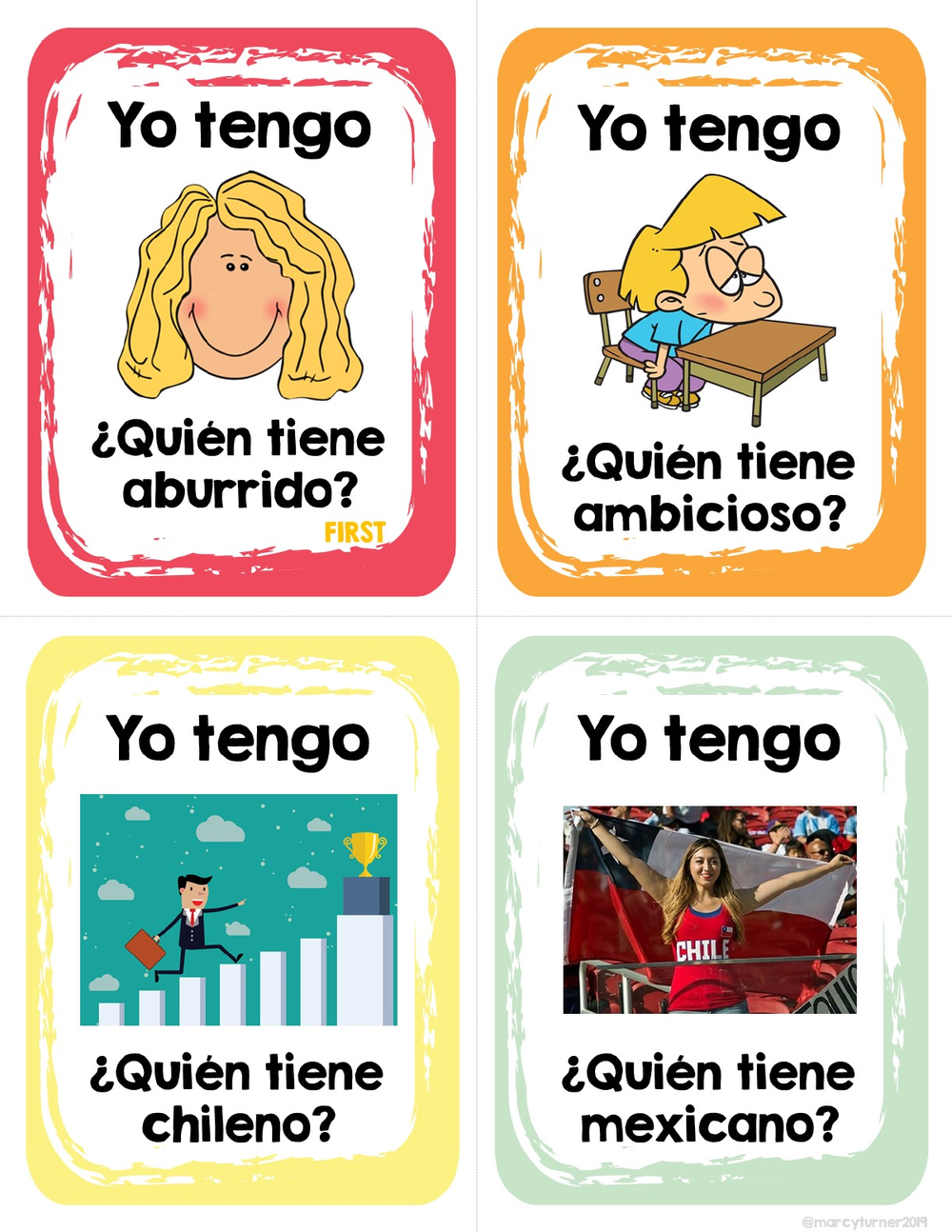
Each card says Yo tengo at the top, with a picture under it. The picture is the word the student has. At the bottom the card asks ¿Quién tiene...? and names a different word. Yo tengo means “I have” and ¿Quién tiene? means “Who has?”
Look at the first page of the file. The card marked FIRST shows a person with blond hair, so that student has rubio, and its question asks ¿Quién tiene aburrido? The next card shows a bored student at a desk. That student has aburrido and asks ¿Quién tiene ambicioso?
How to teach Spanish descriptive adjectives with this game, step by step
These are the steps from the How to Play page, the last page of the free file.
- Print, cut and laminate all of the cards.
- Pass out all of the cards. If there are more cards than students, let students raise their hands if they would like more than one. As you hand them out, encourage students to think about what the question for their card might be, so they are ready to answer.
- Ask the student whose card says FIRST to begin. They read a statement first, such as “Yo tengo grande,” and then the question, such as “¿Quién tiene rubio?”
- Everyone looks at their cards. The student with the answer to the question reads next.
- The game goes around the group until the student who had the first card reads again. The last card is labeled LAST, in case there are any issues.
- Have fun.
Describing words: alto, pequeño and 21 more
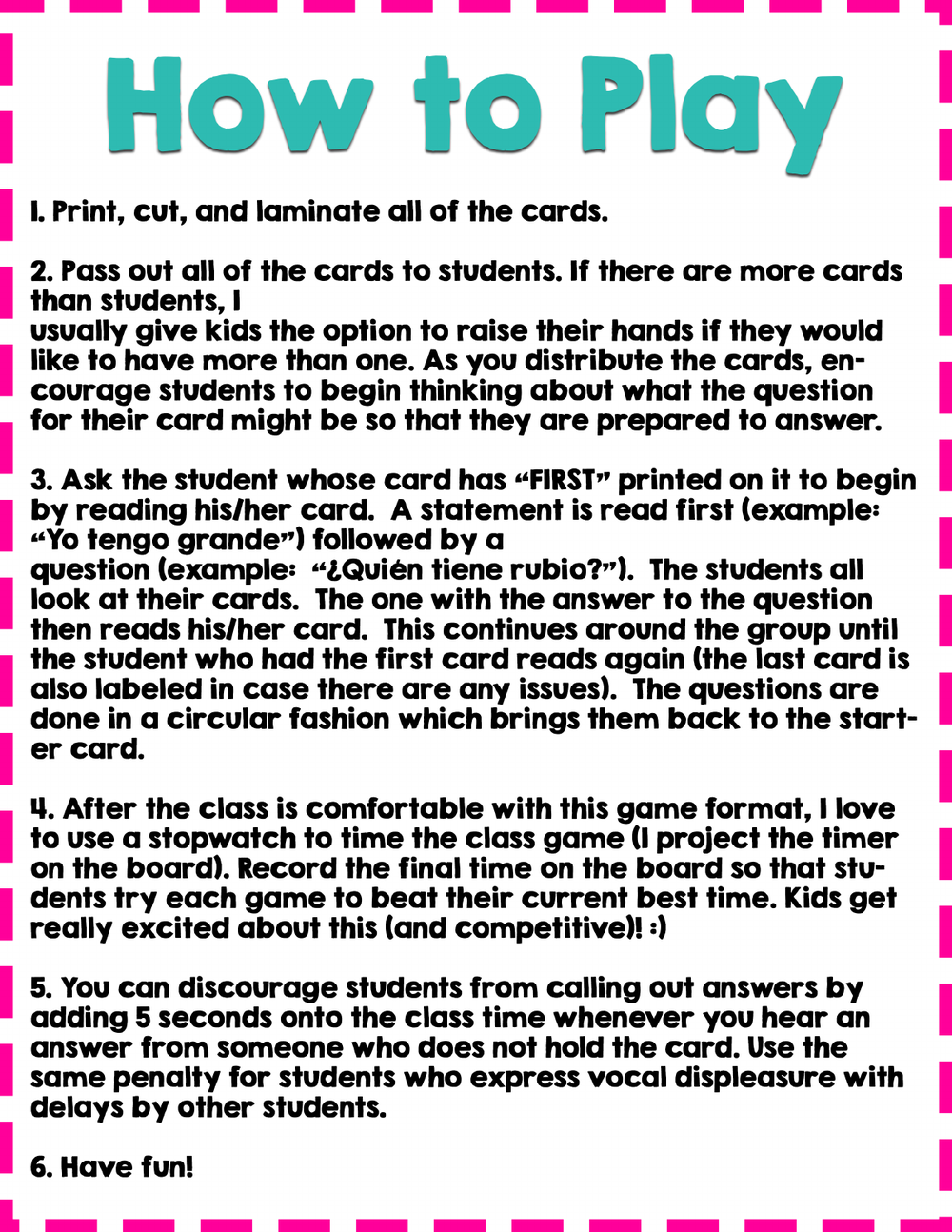
Twenty-three of the 61 cards are describing words. The pictures do the teaching: a tall person standing next to a short one is alto, and a big apple next to a small one is pequeño. The students who hold those pictures listen for ¿Quién tiene alto? and ¿Quién tiene pequeño? before they read.
Spanish nationalities and languages
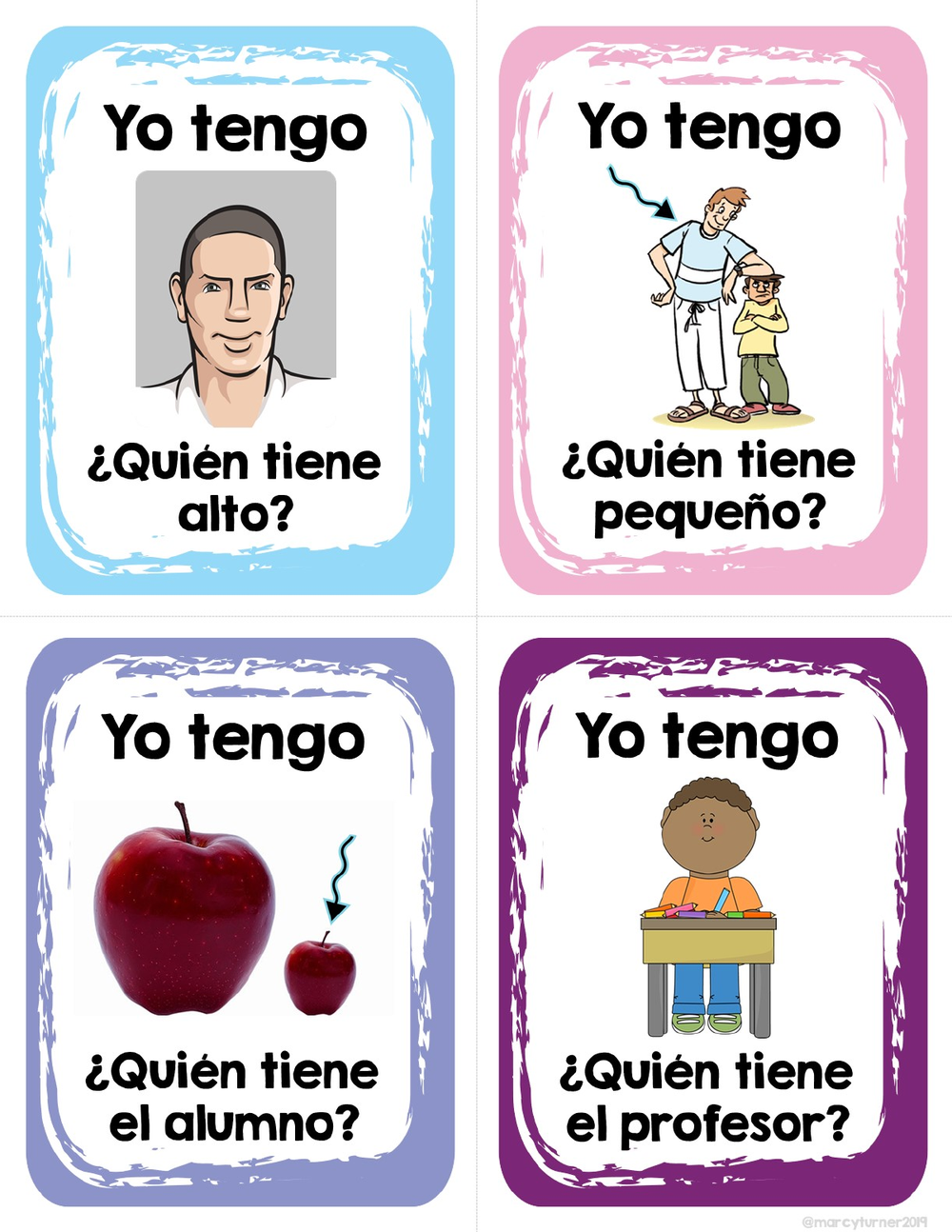
Fourteen cards are about where people are from and what they speak: twelve nationalities, from chileno and mexicano to argentino and español, plus el inglés and el francés. The pictures are flags, people and place names. The word ENGLISH in big letters is el inglés, and “Do You Speak French?” circled in red is el francés.
School subjects: from las matemáticas to el arte
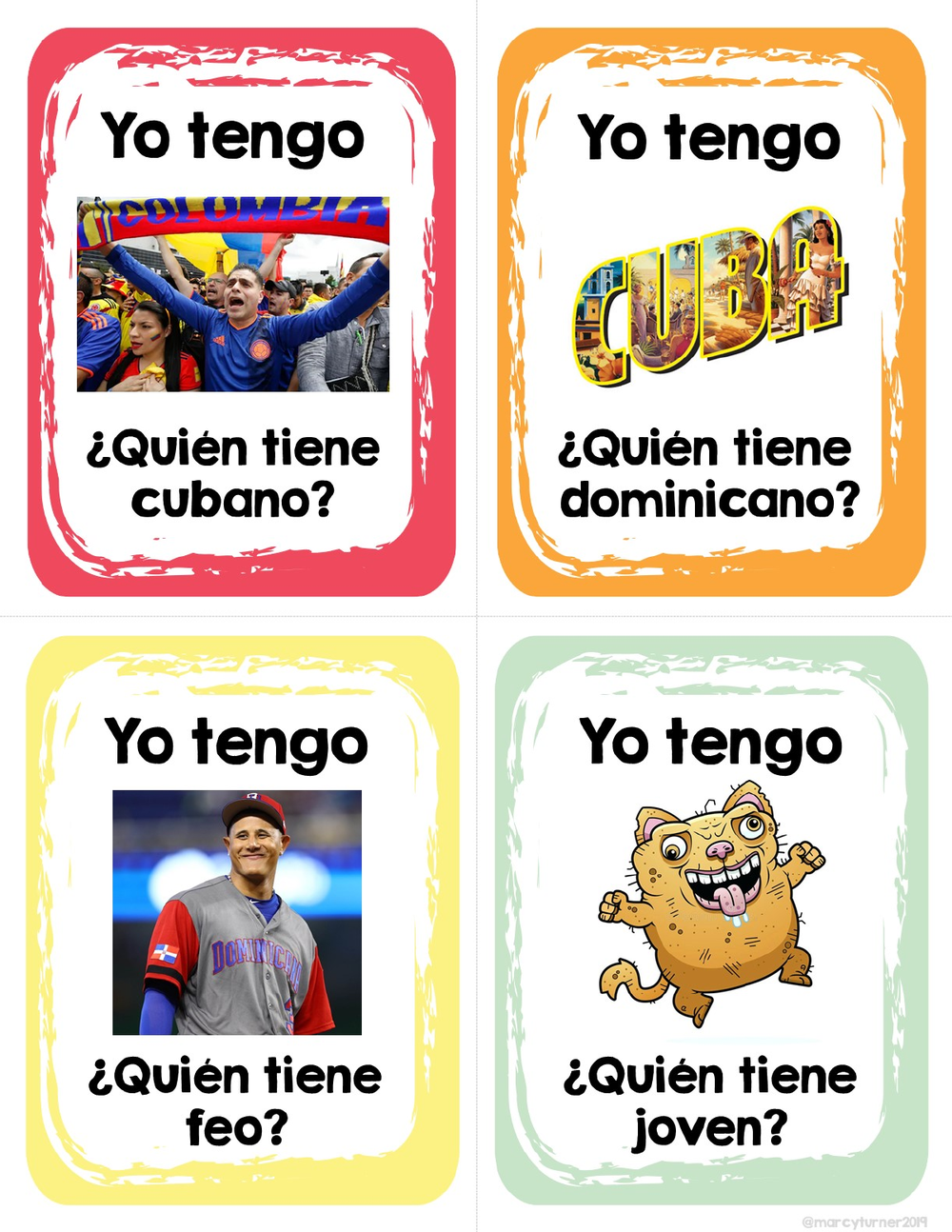
Seven cards are school subjects: los estudios sociales, la historia, las matemáticas, la música, la educación física, la ciencia and el arte. Math symbols are las matemáticas, music notes are la música, and the word NEW in big letters is nuevo, so students can match each picture to its word at a glance.
Time the class and try to beat your best time
After the class is comfortable with the game, I love to use a stopwatch to time the class game. I project the timer on the board and record the final time, so students try to beat their current best time each time they play. Kids get excited about this, and a little competitive.
To discourage students from calling out answers, add 5 seconds to the class time whenever you hear an answer from someone who does not hold the card. Use the same penalty for students who show displeasure with delays by other students.
Make your own cards with the blank pages
The last two pages of cards are blank Yo tengo cards, eight in all, with the same colorful borders. They are editable in Adobe PDF, so you can type your own words into them. Only those two pages are editable, and the font on the cards is called KG Second Chances Solid.
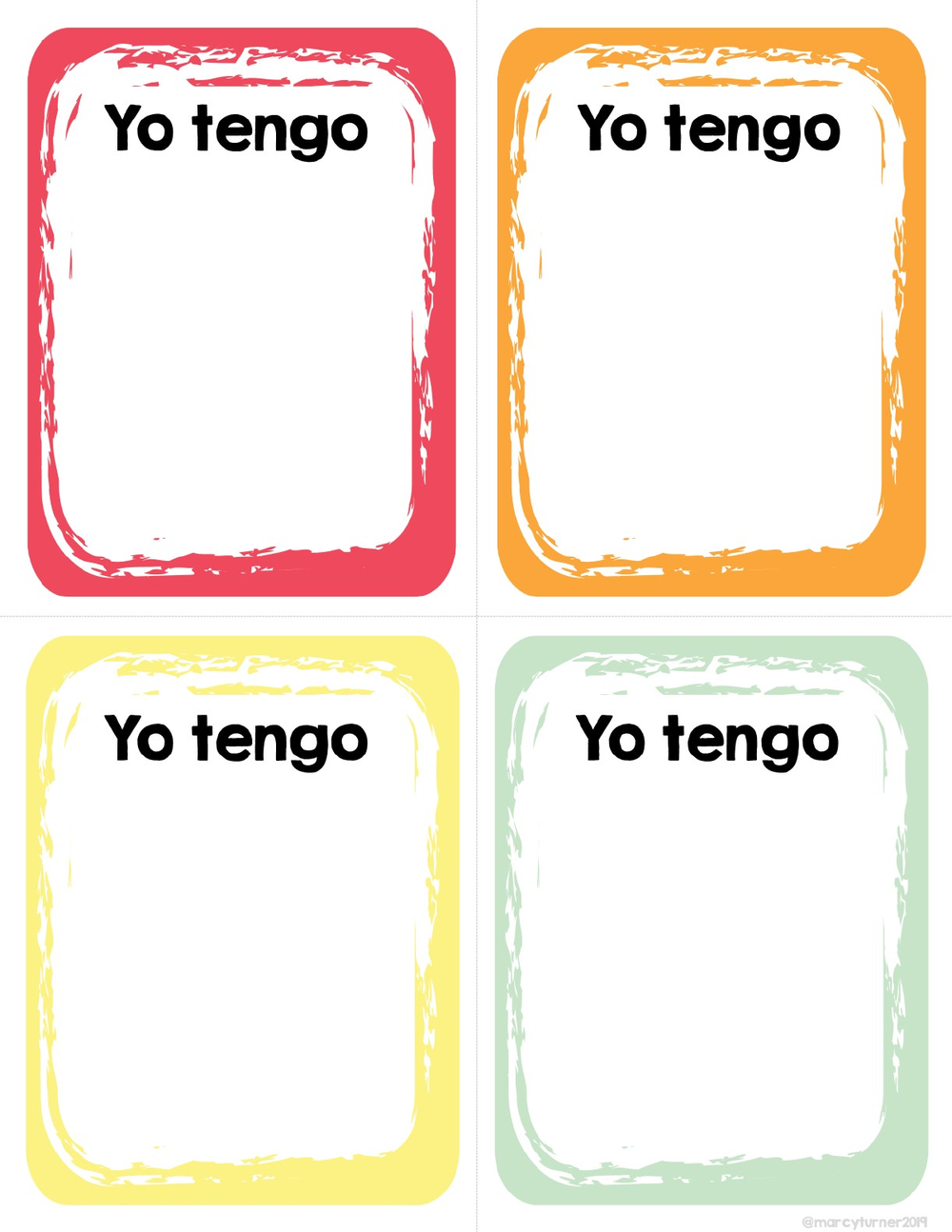
Here is the free Spanish descriptive adjectives game
Click the file. It opens on the downloads page. No email needed.
This game is from our Así se Dice 1 Chapter 1 lessons
- Así se Dice 1 Ch 1 Printable Flashcards - Descriptive Adjectives
- Así se Dice 1 Ch 1 Digital Flashcards
- Así se Dice 1 Ch 1 Printable Task Cards - Descriptive Adjectives
- Así se Dice 1 Ch 1 Digital Task Cards
- Así se Dice 1 Ch 1 Bingo - Descriptive Adjectives
- Así se Dice 1 Ch 1 Boom Cards - Descriptive Adjectives
- Así se Dice 1 Ch 1 Yo Tengo, ¿Quién Tiene? Printable Game
- Así se Dice 1 Ch 1 Digital ¿Qué Falta? Game
- Así se Dice 1 Ch 1 Digital Mystery Picture Worksheets
See everything in the membership
Questions teachers ask about Spanish descriptive adjectives games
How do you play yo tengo quién tiene in Spanish?
Print, cut and laminate the 61 cards and pass them out. The student whose card says FIRST begins: they read Yo tengo and the word for their picture, then the question at the bottom of the card. The student with the answer reads next, and the game goes around the room until the first student reads again.
Which Spanish descriptive adjectives are in the game?
There are 23: aburrido, ambicioso, feo, joven, difícil, cómico/gracioso, bueno, bonita, inteligente, interesante, perezoso, nuevo, simpático, antipático, pelirrojo, serio, alto, pequeño, guapo, malo, grande, rubio and moreno. The full list of all 61 words is above.
What if you have more cards than students?
I usually give kids the option to raise their hands if they would like to have more than one card. As you pass the cards out, encourage students to think about what the question for their card might be, so they are prepared to answer.
How do you stop students from calling out answers?
When you time the class game with a stopwatch, add 5 seconds to the class time whenever you hear an answer from someone who does not hold the card. Use the same penalty for students who show displeasure with delays by other students.
Can you edit the cards?
Yes, the last two pages of cards are blank and editable in Adobe PDF. Only those two pages can be edited. The font on the cards is called KG Second Chances Solid.
Pin this for later
Want every Spanish resource, ready to teach?
The membership has 100+ no-prep resources in six topic courses, and I add new ones as I finish them. $149 a year, or $49 every three months. Cancel anytime.
Get 5 free no-prep Spanish activities
Ready to print and use tomorrow. I send them straight to your inbox. No credit card.
Your email is safe with me. Unsubscribe anytime.